The Singh Twins
The Singh Twins are internationally recognised, award-winning contemporary British artists, known for their highly detailed, narrative, symbolic and eclectic style which is rooted in Indian miniature painting aesthetics but also draws on the stylistic conventions and symbolic language of other artistic traditions from across the centuries. Describing their art as Past-Modern, the twin sisters combine hand-painted techniques with modern digital creative technologies to create works in different mediums that explore both historical and current themes around society, politics and culture; demonstrate the contemporary relevance of history and tradition; and challenge Eurocentrism in the artworld and in wider society. Inspired by their identity and experience as British Asians, they are especially interested in dialogues around empire, colonialism and their legacies.
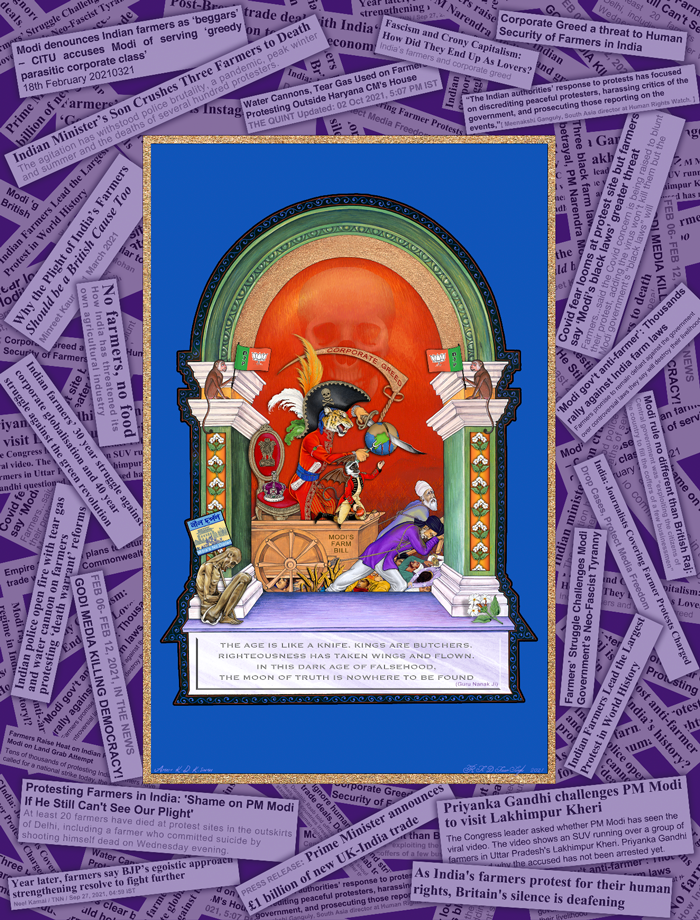
Eating Off the Same Plate II
Farmers’ Plight (Slaves of Fashion series)
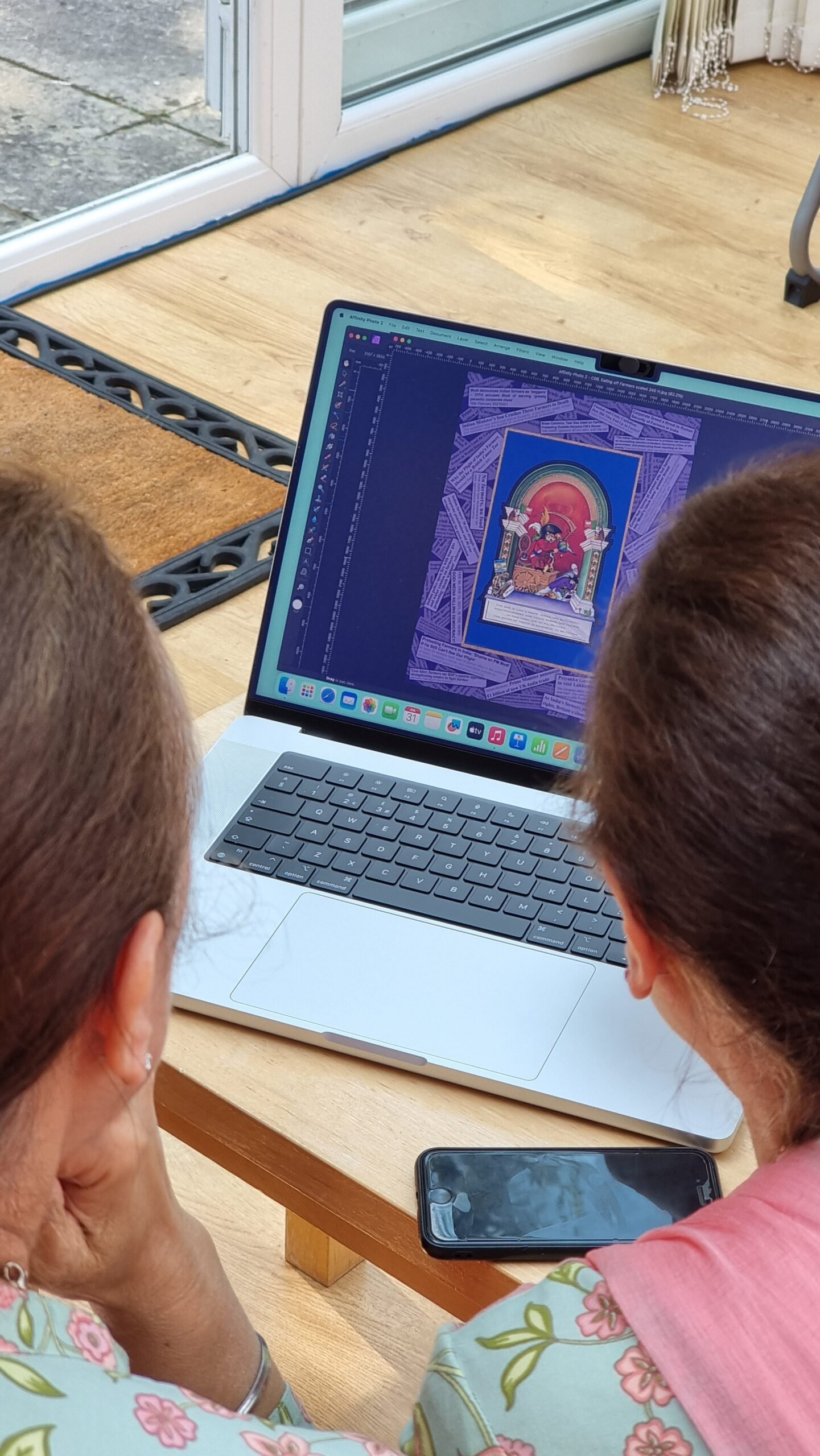
This artwork is a response to the Indian government’s passing of three controversial farm laws* in 2020 enabling private corporations to control the sales, pricing and storage of agricultural produce in India – regulations dubbed the ‘black laws’ by India’s farming communities who came out in their thousands to protest against them, claiming that the laws offered them no protection from market forces and put their farms and livelihoods at risk. As the party responsible for introducing the laws, Modi’s BJP government is symbolically depicted within the artwork as an Indian tiger dressed in the garb of an Indian king and a pirate, carving up and handing India’s green agricultural land to a monkey denoting corporate greed. The monkey is dressed in the uniform of the colonial East India Company which, independently and also as an agent of the British Empire, land-grabbed, exploited and impoverished India’s agricultural communities. In this respect Modi’s government is portrayed as behaving no better than India’s former imperial masters. This parallel between past imperial trade practices and current trade policy in India is reinforced by the emaciated figure of a Bengal farmer, representing the Indigo famines that occurred during the 19th century under the British Raj, when farmers were forced to grow cash crops for British export, rather than food. Two Indian farmers are shown being forced to pull a ‘Modi’s Bill’ cart which crushes their community and food crops under its wheels. The suggestion that Indian politics today walks in the shoes of the British Empire is further symbolised by the British Imperial State Crown, placed on a gilded chair emblazoned with the Ashok Chakra (the country’s state emblem), denoting the Indian seat of power. Under the tiger’s belt is a scroll inscribed with the words ‘Media Control’. This is inspired by an Amnesty International report (9 February 2021) which condemned attempts by the Modi government to crush farmer protests and silence critics of the farm laws through manipulation of the Indian press, suspension of internet services, and social media censorship. Written on the plinth which supports the archway above the tiger are verses from the hymns of Guru Nanak (1469–1539) which describe the falsehood and tyranny of his times. The description resonates with quotations from news websites and social media (in the surrounding border of the archway) which highlight the Indian authorities’ unfair and heavy-handed response to protestors. Further news clippings around the border reveal some of the sources of inspiration behind the key themes explored within the artwork.
All about The Singh Twins
In 2010 they were made Honorary Citizens of Liverpool. In 2011 they each received an MBE from Queen Elizabeth II for ‘services to the Indian miniature tradition of contemporary art’ and, in 2015, were awarded an Honorary Doctorate of Fine Art from the University of Chester for their ‘outstanding contribution to British art’. In 2019 they received an Honorary Doctorate of Letters from the University of Liverpool and in 2020 were awarded an Honorary Doctorate of Art by the University of Wolverhampton for their contribution to diversity in the arts. Their hugely successful exhibition Slaves of Fashion at Firstsite Gallery in 2022 led to their being put forward by public curator nomination to be considered by the jury to represent Britain at the Venice Biennale in 2024.
Photos from our Interview